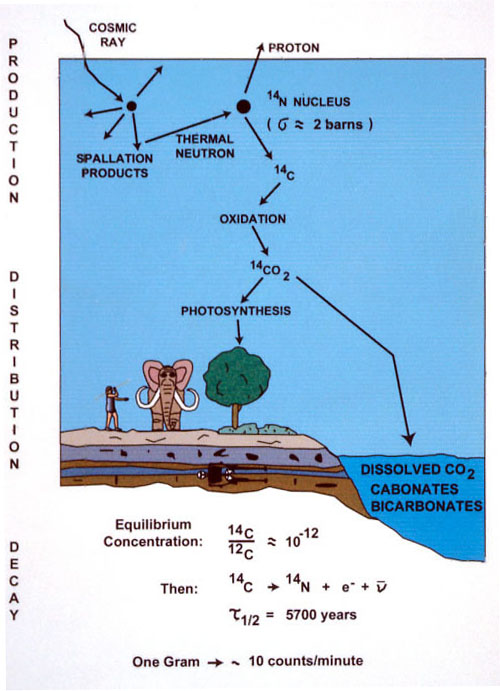
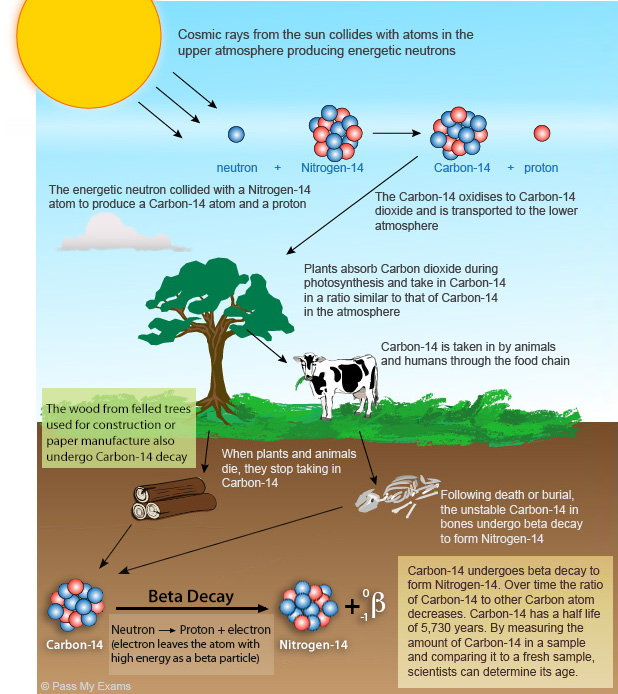
Carbon, 14C, or radiocarbon, is a radioactive isotope of carbon with an atomic nucleus containing 6 protons and 8 neutrons. Its presence in organic materials is the basis of the radiocarbon dating method pioneered by Willard Libby and colleagues () to date archaeological, geological and hydrogeological samples. Carbon, 14C, or radiocarbon, is a radioactive isotope of carbon with an atomic nucleus containing 6 protons and 8 neutrons. Its presence in organic materials is the basis of the radiocarbon dating method pioneered by Willard Libby and colleagues () to date archaeological, geological and hydrogeological samples. Carbon Dating. Presuming the rate of production of carbon to be constant, the activity of a sample can be directly compared to the equilibrium activity of living matter and the age calculated. Various tests of reliability have confirmed the value of carbon data, and many examples provide an interesting range of application.
14 Carbon Dating. How Carbon is Made - Carbon Atoms | HowStuffWorks
The stable isotopes are carbon 12 and carbon The carbon method was developed by the American physicist Willard F. Fossil fuels have 14 carbon dating carbon content, and the burning of those fuels over the past years has diluted the carbon content. It is taken as fact and used as evidence to 14 carbon dating information on the world and past civilizations. From Wikipedia, the free encyclopedia. There is plenty of evidence that the radioisotope dating systems are not the infallible techniques many think, and that they are not measuring millions of years.
14 carbon dating -
These values have been derived through statistical means. These atoms have one or two more neutrons in the nucleus than most Carbon atoms. Additional complications come from the burning of fossil fuels such as coal and oil, and from the above-ground nuclear tests done in the s and s. We just need to keep it in perspective and not take a theory for a fact. This is the reverse of the way the curve is constructed: Radiocarbon, or carbon 14, is an isotope of the element carbon that is unstable and weakly radioactive. Radiocarbon dating is a radiometric dating method that uses 14 C to determine the age of carbonaceous materials up to about 60, years old. Calibration of radiocarbon dates. To determine this, a blank sample of old, or dead, carbon is measured, and a sample of known activity is measured. Any text you add should be original, not copied from other sources. A separate issue, related to re-use, is that of lengthy use, or delayed 14 carbon dating. For 14 carbon dating, two samples taken from the tombs of two Egyptian kings, Zoser and Sneferuindependently dated to BC plus or minus 75 years, were dated by radiocarbon measurement to an average of BC plus or minus years. However, it decreases thereafter from radioactive decay, allowing the date of death or fixation to be 14 carbon dating.
-
-
-
-